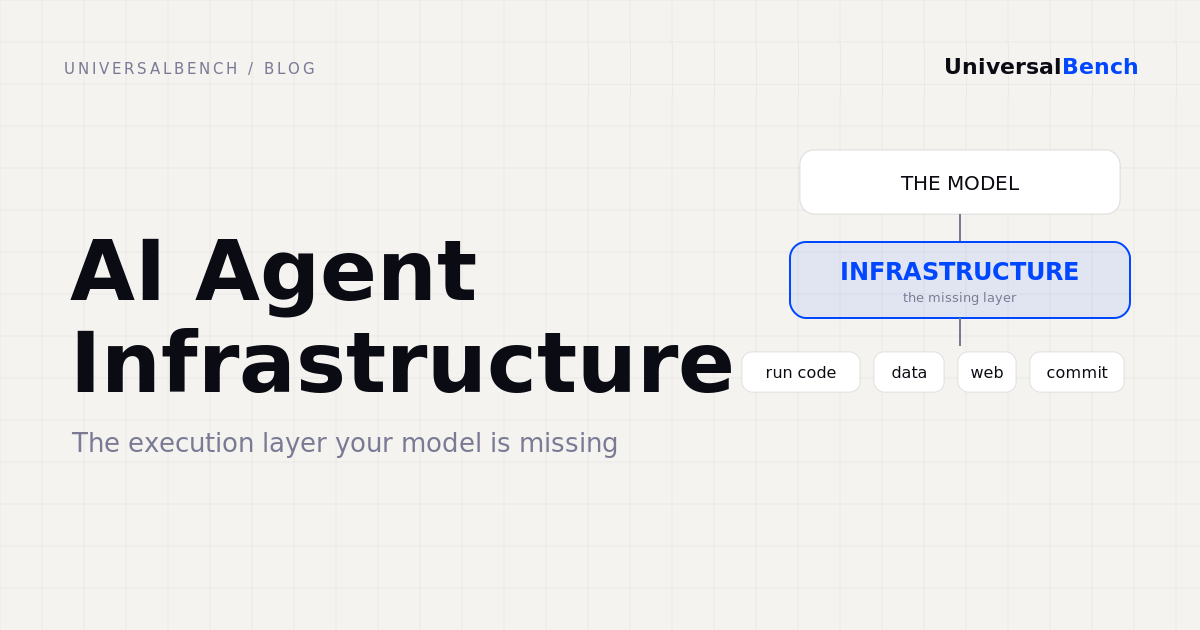
An AI model is the most capable reasoning engine most companies have ever had access to. It can read a problem, plan a fix, and write the exact code to solve it. Then it stops, because it cannot run that code, open that database, fetch that page, or commit that change. The intelligence is real. The hands are missing.
AI agent infrastructure is the layer that gives the model hands. It is the execution environment that sits between an agent deciding what to do and the work actually happening: running code, reading and writing data, reaching the web, and committing changes, with guardrails enforced underneath. Models improve every month. The infrastructure around them is what decides whether an agent is a clever chatbot or something that gets real work done.
What AI agent infrastructure actually means
Infrastructure here does not mean servers or orchestration. It means the set of capabilities an agent can call to act on the world, plus the controls that keep those actions safe. A model on its own can only produce text. The moment you want it to do something, run a script, query a warehouse, post to an API, you need an execution layer that accepts the model's intent, performs the action in a real environment, and returns only the result. Everything useful an agent does happens in that layer, not in the prompt.
Why the model alone hits a wall
Teams discover this fast. You connect a capable model, ask it to analyse a log file, and it confidently invents an answer because it cannot actually open the file. You ask it to check live pricing and it apologises that it cannot browse. You ask it to fix a bug and it writes code it has no way to test. The ceiling is not intelligence. It is the lack of a place to act. Bigger prompts and longer context do not fix this. Pasting a whole log into the chat just burns tokens and still leaves the model guessing instead of counting.
The four things an agent needs to act
Across real agent workloads, the capabilities that matter collapse to four.
Run code. The single highest-leverage capability. A model that can execute Python stops guessing and starts computing. It counts the errors instead of estimating them, and it is right.
Read and write data. Most useful work touches a database. The agent needs structured, safe access to query and update records without you handing over the keys to everything. We covered the safe pattern in safe AI database access.
Reach the web. Live search and HTTP, so answers reflect this week, not the training cutoff.
Commit changes. Push code, write files, ship the result, so the work leaves the sandbox and lands somewhere real.
The part everyone skips: safety lives below the agent
Here is the difference between a demo and something you would run against production. Most agent setups put the safety rules in the prompt, where the model can ignore them, forget them, or be talked out of them. Real infrastructure enforces the limits underneath the agent, where the model cannot reach them. Three controls matter most.
If the controls live in the prompt, they are suggestions. If they live in the infrastructure, they are guarantees. That is why we wrote separately about why your AI should not log in as you and why agent costs spiral without a hard cap.
Why infrastructure beats a bigger prompt
The counterintuitive payoff is cost. When the agent runs code in the execution layer and only the result returns to the model, you stop shipping raw data through the context window. On one real log analysis task, doing the work in chat cost 4,024 input tokens and produced the wrong error count. Doing the same work through an execution layer cost 141 tokens and produced the correct count, a 96.5 percent reduction on the same task. Infrastructure is not just what makes an agent capable. It is what makes it cheap.
What to look for when you choose agent infrastructure
A few questions cut through the noise. Does it work with any model, or lock you to one vendor. Are the safety controls enforced in the platform or just described in the docs. Does it return clean results, or dump raw data back into your context. Can you connect it with one URL, or is it a week of integration. The right answer to all four is the difference between an agent you trust with real work and one you babysit.
Common questions
What is AI agent infrastructure? It is the execution layer that lets an AI agent act: run code, read and write data, reach the web, and commit changes, with safety controls enforced below the agent rather than in the prompt.
Why can the model not do this alone? A model only produces text. To take an action it needs an environment that runs the action and returns the result. Without that layer it guesses instead of doing.
Does more context replace infrastructure? No. Larger prompts cost more and still leave the model estimating. Running the work and returning only the answer is both cheaper and more accurate.
How do you connect it to an agent? With a single MCP URL that any MCP-compatible AI can use. See how to connect a code-running tool to your AI.
Give your agent the infrastructure to act.
1,000 free calls per month. One URL. Any MCP-compatible AI agent.
Get your API key