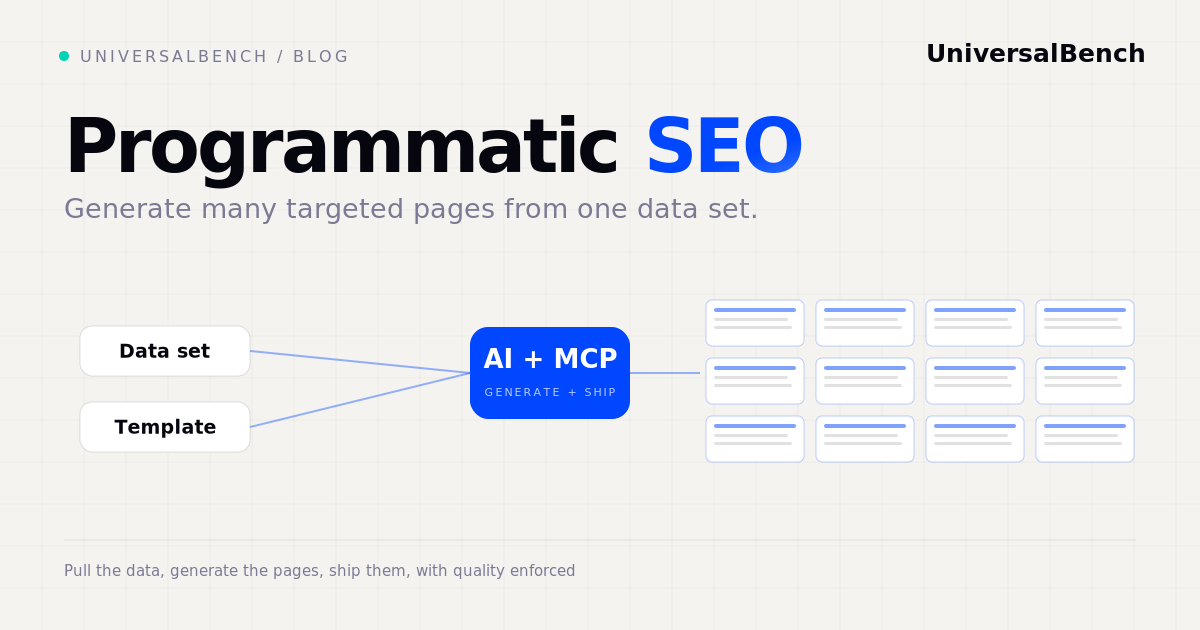
Programmatic SEO is the practice of generating many web pages at scale from a structured data set and a single template, where each page targets a specific long-tail search query. Instead of writing one page by hand, you write one template and let data fill it, producing hundreds or thousands of pages that each answer a narrow, specific question. Think of pages like "best running shoes for flat feet" across every variation, or "cost of living in" every city. Done well, it captures large amounts of long-tail search demand that would be impossible to cover one article at a time. Done badly, it produces thin, near-duplicate pages that Google ignores or penalises.
What is programmatic SEO?
It is templated page generation aimed at search. You start with a repeatable search pattern, a query shape that people search with many different values filled in, and a data set that holds those values plus the facts each page needs. A template maps the data onto a page layout. Generate one page per row, and you have covered the whole pattern. The skill is not the generation, that part is easy. The skill is making each page genuinely useful, not just a find and replace of a single value.
How programmatic SEO works
Three pieces make it work. First, a keyword pattern with real search demand behind its variations, for example "[service] in [city]". Second, a data set that has a row for each page and columns for every fact the page needs. Third, a template that turns one row into one complete, unique page, with its own title, heading, content, and internal links. You generate the pages, publish them, and submit them so search engines can find and index them. The quality of the data set is what separates useful pages from filler.
Common types of programmatic pages
Most programmatic SEO falls into a few shapes. Directory pages list entities in a category, such as tools, companies, or places. Location pages cover a service across many cities or regions. Comparison pages pit one option against another, like "X vs Y". Long-tail answer pages answer a specific question repeated across many subjects. Each works only when the underlying data gives every page something real and distinct to say.
The quality problem
The failure mode of programmatic SEO is thin content: thousands of pages that differ by only a word or two and add no real value. Search engines are good at spotting this, and a wave of near-duplicate pages can hurt a whole site, not just the weak pages. The fix is not technical, it is editorial. Every generated page must earn its place by answering its query better than an empty template would. If a page would not help a real person, it should not exist, no matter how cheap it is to generate.
How to do programmatic SEO well
Four habits separate the wins from the penalties. Use real, rich data, so each page carries facts a visitor actually wants, not padding. Target real demand, build only for query patterns people genuinely search, which you can check against search volume data, see SEO data APIs compared. Add genuine value per page, unique content, useful structure, not just a swapped variable. Link internally, so the pages support each other and pass authority. Then measure with the Search Console API and prune pages that never earn clicks.
Generating pages with UniversalBench
Here is the part that changes your workflow: you do not build any of this yourself. You connect one URL and ask in plain language. Paste your UniversalBench address, universalbench-mcp.penantiaglobal.workers.dev/u/your-key, into Claude, ChatGPT, Gemini, or any MCP-compatible AI. That single connection is the whole setup.
Then you ask, for example:
"Pull this CSV of cities, generate a unique page for each, and commit them to my site."
Behind that one request, UniversalBench:
- reads your data, a CSV, a database, or an API, over the one connection
- generates a distinct, genuinely useful page per row in real code, not a find and replace of one value
- validates every page and commits it to your site, with any broken page rejected before it lands
That turns programmatic SEO from a fragile scripting project into a single request that scales to thousands of pages, because the heavy work runs on the server, not in the chat. And the guarantees hold the entire way: your AI never ships broken code, never exceeds the cost ceiling you set, and cannot reach a private network. These very blog pages were generated and shipped through UniversalBench, the same pull, generate, validate, commit path described here.
Questions about programmatic SEO
Is programmatic SEO against Google's rules? No, the technique is fine. What Google penalises is thin, unhelpful content, whether it is generated programmatically or by hand. Useful pages are welcome at any scale.
How many pages can I make? As many as you have good data for. The limit is quality data, not generation. Stop where the data stops giving each page real value.
Do I need to code to do programmatic SEO? Traditionally yes. With an AI connected to your data and site, you can describe the pattern and let it pull, generate, and publish for you.
How do I know if it is working? Track the generated pages in the Search Console API. Pages that gather impressions and clicks are working, pages that never do should be cut.
Generate SEO pages at scale, safely
Connect one URL and let your AI pull the data, generate unique pages, and ship them, with quality and cost enforced below the agent.
Get your API key