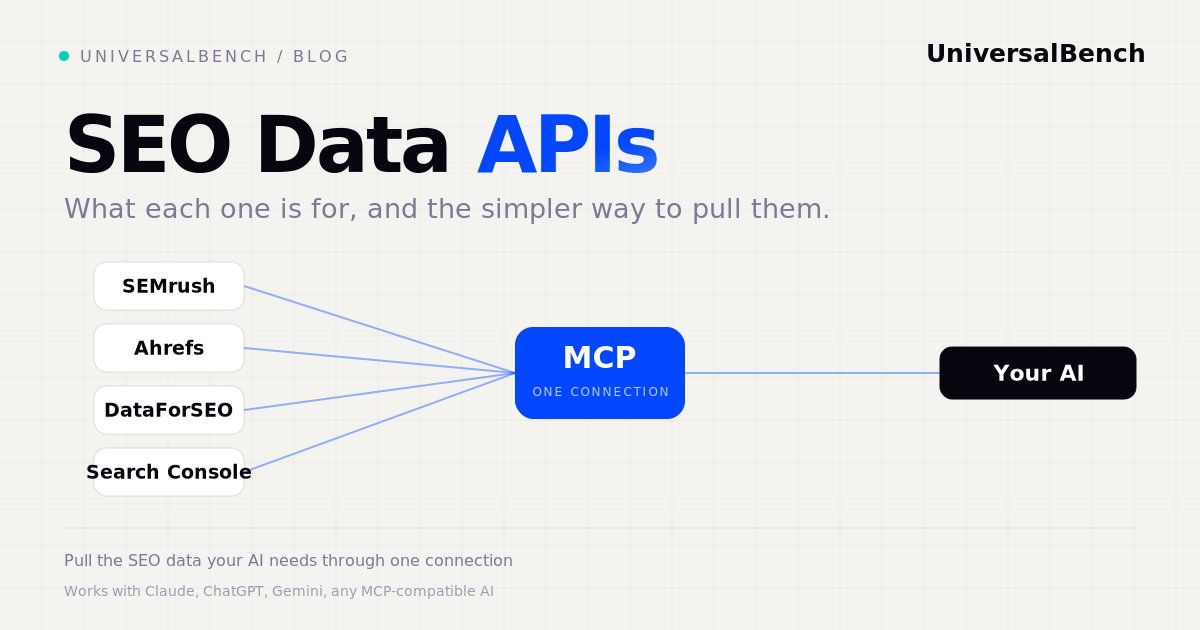
An SEO data API gives you programmatic access to search data: keyword search volumes, keyword ideas, ranking positions, backlinks, and your own site's search performance. Instead of clicking around a dashboard, you call an endpoint and get structured data back, which you can feed into reports, tools, or an AI workflow. The main options are SEMrush, Ahrefs, DataForSEO, and the Google Search Console API. They are not interchangeable. Each is built for a different job and priced in a different way. This guide explains what each one is best for, then shows a simpler way to pull the SEO data an AI workflow actually needs.
What is an SEO data API?
It is an interface that returns SEO metrics as data rather than as a web page. Some APIs expose a vendor's own crawled index of the web, such as keyword databases and backlink graphs. Others return live search engine results, or your own verified site data. The right choice depends on which data you need, how much of it, and what you can spend, since pricing models differ sharply between providers.
SEMrush API
SEMrush is known for a large keyword and competitive dataset. Its API exposes keyword metrics, domain analytics, and competitor research drawn from its own index. It suits agencies and product teams that want broad market and competitor data and are comfortable with usage based pricing on a higher tier plan. If your work centers on competitive keyword research at scale, SEMrush is a strong fit.
Ahrefs API
Ahrefs is best known for its backlink index, one of the largest in the industry, alongside keyword and rank data. Its API is the natural pick when backlink analysis is central to your work, for example link audits, competitor backlink research, or monitoring referring domains. Like SEMrush, access is usage based and sits on the paid tiers, so it rewards teams that lean heavily on link data.
DataForSEO API
DataForSEO is a developer first, pay as you go API. It returns search results, keyword data, and rank tracking across many endpoints, billed by the request rather than a flat subscription. That makes it a popular backend for people building their own SEO tools, dashboards, or automations cheaply, because you pay only for what you call. If you are building software and want raw SERP and keyword data without a large fixed cost, DataForSEO is usually the cheapest entry point.
Google Search Console API
The Google Search Console API is free, but it only returns data for sites you have verified. It gives you the real clicks, impressions, average position, and queries that Google recorded for your own pages, which no third party dataset can match for your own site. The limit is the point: it is your data only, not the whole web. For tracking how your own pages actually perform in Google, it is the most accurate source there is, and it costs nothing.
Rank tracker APIs
Dedicated rank tracker APIs do one job well: check where a set of keywords ranks, on a schedule, often by location and device. If your only need is position tracking, a focused rank tracking API can be simpler and cheaper than a full SEO suite. Several providers, including DataForSEO, offer this as a specific endpoint.
Which SEO data API should you use?
A quick way to decide: for competitive keyword research at scale, SEMrush. For backlink analysis, Ahrefs. For cheap, build it yourself SERP and keyword data, DataForSEO. For your own site's real Google performance, the free Search Console API. Many teams end up using more than one, which is where the integration cost starts to add up: separate accounts, separate auth, separate response formats, all stitched together by hand.
Pulling SEO data through UniversalBench
Here is the part that changes your workflow: you do not build any of this yourself. You connect one URL and ask in plain language. Paste your UniversalBench address, universalbench-mcp.penantiaglobal.workers.dev/u/your-key, into Claude, ChatGPT, Gemini, or any MCP-compatible AI. That single connection is the whole setup.
Then you ask, for example:
"Find the ten queries my site ranks just below page one for, and draft a content brief for each."
Behind that one request, UniversalBench:
- reads your own Search Console performance and pulls live search volumes over the one connection, no separate accounts, keys, or response formats to manage
- ranks the opportunities in real code by search volume and current position, so the shortlist is computed, not guessed
- hands your AI ten finished briefs, not a spreadsheet to wade through
One request replaces a pipeline of separate API calls, auth, and glue code. The work runs on the server, so your AI reads only the finished answer, which is faster and far cheaper than pulling raw data into the chat. It is not a full backlink index like Ahrefs, it is the fastest path when you want an AI to use SEO data, not a human to browse a dashboard. And the guarantees hold the entire way: your AI never ships broken code, never exceeds the cost ceiling you set, and cannot reach a private network. In fact, the keyword research behind this very post, the search volumes that decided which guides to write first, was pulled through UniversalBench.
Questions about SEO data APIs
What is the cheapest SEO data API? For raw SERP and keyword data, DataForSEO's pay as you go model is usually the cheapest. For your own site's data, the Google Search Console API is free.
Is the Google Search Console API enough on its own? Only for your own verified sites. It cannot give you competitor or whole market data, so most teams pair it with a third party API for that.
Can I use SEO APIs without coding? Through an AI connection, yes. You connect once and ask in plain language, and the model calls the data for you.
Do these APIs return the same numbers? No. Each uses its own index and method, so search volumes and difficulty scores differ between providers. Treat them as estimates, and trust your own Search Console data for your own pages.
Let your AI pull SEO data
Connect one URL and your AI can pull search volumes, keyword ideas, and your own Search Console performance, with safety enforced below the agent.
Get your API key