Give an AI agent the ability to write and commit code, and most of the time it works. The trouble is the rest of the time. The model writes something that reads perfectly, sounds confident in its explanation, and does not compile. Or it compiles and then crashes the moment the program starts. The agent does not know. It already moved on to the next step.
We learned this the hard way while building our own platform. Not from a whitepaper. From watching a confident commit take a service down. This post is about what we changed, why a green checkmark is not the same as working software, and how you can use these protections to ship faster instead of slower.
The failure nobody designs for
A coding agent fails in three ways, and they get progressively harder to catch.
It does not compile
A missing bracket, a bad indent, a typo in a keyword. Obvious once a human looks, invisible to an agent that never ran it.
It compiles but breaks at startup
The syntax is clean, so a basic check passes. Then the program tries to start and a deeper error throws. The kind a simple parser never sees.
It deploys, and the wrong version goes live
The build reports success. A green tick. Underneath, the new code never actually started serving, and the old version quietly kept running. No alarm. You think you shipped a fix. You did not.
The third one is the one that cost us the most. A build went green and we believed it. The new code had crashed on startup and the platform silently rolled back to the previous version. Nothing told us. We were debugging a fix that was never live. That single experience reshaped how we think about the word done.
What "never ships broken code" actually means
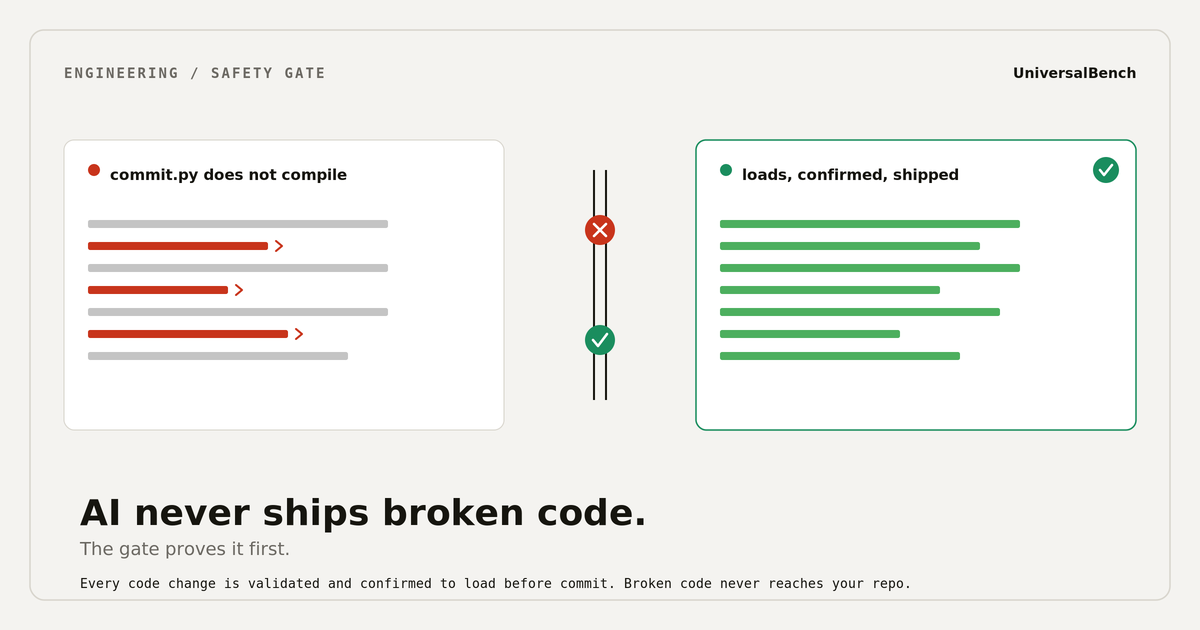
The promise is simple to say and harder to earn. When an AI agent uses UniversalBench to commit code, the code is checked and confirmed to load before the commit lands. Not after. Not on the next deploy. Before. If it would not start, it does not ship.
Here is the difference in practice, using the exact failure that bit us.
Three protections, working together
The guarantee is not one trick. It is a few layers that each close a different gap.
It runs in an isolated sandbox
Agent code executes in a sealed environment, walled off from your systems and from other workloads. A bad run stays contained. It cannot reach out and break something else while it fails.
It is confirmed to load before commit
Every push is validated and verified to actually start, not just skimmed for obvious typos. The check catches the errors that only surface when a program tries to run.
It rolls back on failure
Point it at a live endpoint and it runs an optional smoke test after deploy. If the new version does not answer correctly, it reverts. You are never left with a dead service and a green checkmark.
It confirms what is actually live
Success is measured by checking the running service, not by trusting the deploy command. A passing build now means the right code is confirmed serving real traffic.
How to use it well
These protections do the most for you when you work with them rather than around them. Everything here is something we learned by getting it wrong first.
Give the deploy a URL to test against
The validation alone confirms code loads. Add a live endpoint and you unlock the smoke test and automatic rollback. This one input turns "it started" into "it actually works."
Batch related changes into one commit
Rapid-fire commits race each other and make failures hard to trace. One logical change, one commit. The gate is cleaner and so is your history when something does go wrong.
Bump a version marker on every change
Carry a version string and change it every time. Then you can ask the live service what it is running and get a straight answer. Knowing exactly what is deployed is half of trusting a deploy.
Never trust a green status on its own
Confirm the new thing is the thing that is serving. Ask the live endpoint, do not assume. A passing checkmark is a starting point for verification, not the end of it.
The same idea, across the platform
"Never ships broken code" is one of three protections that run by default. They are the same principle applied to three different risks.
AI never ships broken code
Every commit is confirmed to load before it lands. Covered above.
AI never burns your wallet
Every model call is cost-estimated before it runs. Calls over your ceiling are rejected by default, so a runaway loop cannot quietly drain your budget.
AI cannot reach your internal network
Every outbound request is checked against a block on private and internal addresses. Agent code cannot be tricked into reaching somewhere it should not.
One URL connects your agent to all of it. It works with Claude, ChatGPT, Gemini, or any MCP-compatible model, and every new protection reaches your AI automatically on the next call.
Related reading
Safety is one half of the story. The other half is cost. See How We Reduced AI Agent Token Costs by 96.5% for the three real tests behind that number.
Let your AI ship. Safely.
1,000 free calls per month. One URL. Any MCP-compatible AI agent. The protections are on by default.
Get your API key